Blockchain technology has transformed how digital systems store data, verify transactions, and establish trust without centralized authorities. While many people associate blockchain only with Bitcoin or cryptocurrencies, the technology itself is far broader and more versatile. To truly understand its impact, it’s essential to explore the types of blockchains and how each one serves different purposes across industries.
This article provides a comprehensive breakdown of the main blockchain types, explaining how they work, how they differ, and why they matter in today’s digital economy.
What Is a Blockchain, at Its Core?
A blockchain is a distributed ledger that records transactions across a network of computers in a way that is transparent, immutable, and secure. Each transaction is grouped into a block, and blocks are cryptographically linked together, forming a chain.
Unlike traditional databases controlled by a single entity, blockchains rely on decentralized consensus mechanisms to validate and record information. This structure eliminates single points of failure and reduces the need for intermediaries.
However, not all blockchains are built the same. Different use cases require different levels of decentralization, privacy, and control—leading to several distinct types of blockchains.
Why Understanding the Types of Blockchains Matters
Knowing the different types of blockchains helps clarify:
- Why some blockchains are fully open while others are restricted
- Why certain systems prioritize transparency while others emphasize privacy
- How enterprises, governments, and individuals use blockchain differently
- Which blockchain models are best suited for finance, supply chains, healthcare, or governance
Each type represents a trade-off between decentralization, efficiency, scalability, and control.
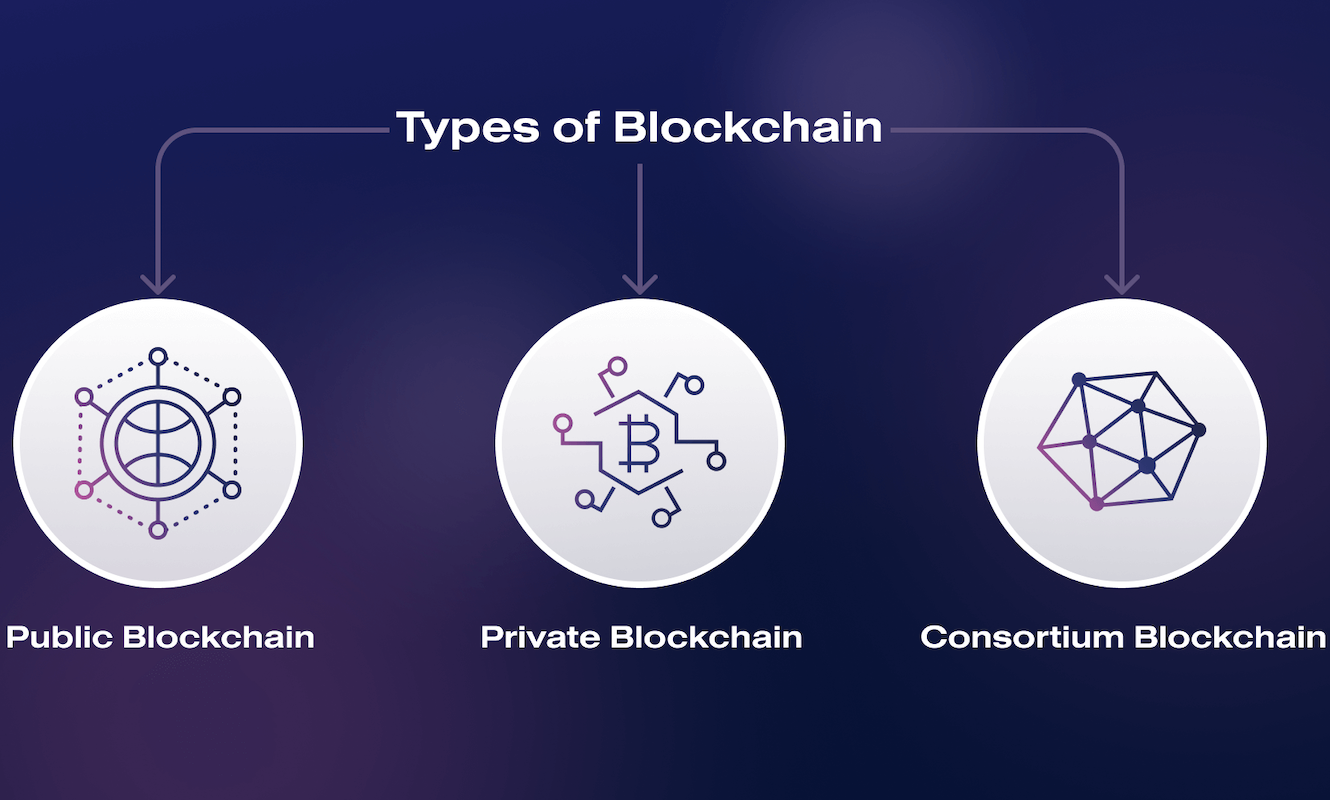
Public Blockchains
Public blockchains are the most well-known and widely discussed type. They are fully decentralized, permissionless networks that anyone can join, read, and participate in.
Key characteristics include:
- Open access: anyone can run a node or validate transactions
- Full transparency: all transactions are publicly visible
- Strong decentralization: no single authority controls the network
- High security through cryptography and consensus mechanisms
Bitcoin and Ethereum are classic examples of public blockchains. They rely on global networks of independent nodes to verify transactions, making censorship or manipulation extremely difficult.
Public blockchains are ideal for:
- Cryptocurrencies
- Decentralized finance (DeFi)
- Non-fungible tokens (NFTs)
- Open, trustless applications
The trade-off is speed and scalability, as high decentralization can slow transaction processing and increase costs during heavy usage.
Private Blockchains
Private blockchains operate in a controlled environment where access is restricted to specific participants. Unlike public blockchains, they are permissioned systems managed by a single organization or consortium.
Key characteristics include:
- Restricted access and participation
- Higher transaction speed and efficiency
- Greater privacy and confidentiality
- Centralized or semi-centralized governance
Private blockchains are often used by enterprises that need the benefits of blockchain—such as immutability and auditability—without exposing sensitive data to the public.
Common use cases include:
- Internal record keeping
- Supply chain management
- Healthcare data systems
- Corporate auditing
While private blockchains sacrifice decentralization, they gain efficiency, compliance, and operational control.
Consortium Blockchains
Consortium blockchains, sometimes called federated blockchains, sit between public and private models. They are governed by a group of organizations rather than a single entity.
Key characteristics include:
- Permissioned access shared across multiple stakeholders
- Partial decentralization
- Improved trust among participants
- Balanced transparency and privacy
In a consortium blockchain, no single organization has full control, which reduces the risk of manipulation while maintaining efficiency.
Consortium blockchains are commonly used in:
- Banking and financial networks
- Trade finance
- Interbank settlements
- Industry-wide data sharing platforms
This model is especially useful when multiple organizations need a shared ledger but do not fully trust one another.
Hybrid Blockchains
Hybrid blockchains combine elements of both public and private blockchains. They allow certain data or processes to be public while keeping other information private and permissioned.
Key characteristics include:
- Flexible access control
- Customizable transparency
- Improved scalability
- Controlled data sharing
For example, a company might use a private blockchain for internal operations while periodically anchoring data to a public blockchain for verification and transparency.
Hybrid blockchains are ideal for:
- Government systems
- Regulated industries
- Enterprise applications with public accountability
- Use cases requiring selective transparency
This model offers a practical balance between openness and control.
Permissioned vs Permissionless Blockchains
Another way to categorize the types of blockchains is by access rules:
Permissionless blockchains allow anyone to join, validate, and participate without approval. Public blockchains fall into this category.
Permissioned blockchains require authorization to participate. Private, consortium, and many hybrid blockchains are permissioned.
The choice between permissioned and permissionless systems depends on trust requirements, regulatory constraints, and performance needs.
Which Blockchain Type Is the “Best”?
There is no universally “best” blockchain type. Each model is designed to solve specific problems.
- Public blockchains excel at trustless, open systems
- Private blockchains prioritize efficiency and confidentiality
- Consortium blockchains enable collaboration among multiple organizations
- Hybrid blockchains offer flexibility for complex, regulated environments
Understanding the types of blockchains allows developers, businesses, and users to choose the right architecture for their goals rather than forcing one model to fit every use case.
The Future of Blockchain Diversity
As blockchain technology matures, the ecosystem continues to diversify. New architectures, layer-2 solutions, and interoperability protocols are emerging to connect different blockchain types and overcome their limitations.
Rather than replacing one another, different blockchain models are increasingly working together—public chains providing transparency and security, while private and consortium chains deliver speed and compliance.
This diversity is a strength, not a weakness, and it highlights how adaptable blockchain technology has become.
Understanding the types of blockchains is essential for anyone interested in cryptocurrency, decentralized applications, or the future of digital infrastructure. Each type reflects a different philosophy about trust, control, and collaboration.
Whether you’re a developer, investor, business leader, or curious learner, knowing how these blockchain models differ will help you navigate the rapidly evolving digital landscape with clarity and confidence.
Blockchain is not a single technology—it’s a family of technologies, each designed for a specific purpose.